Insight
What Your Nervous System Actually Does
May 23, 2026 · Evan Gill
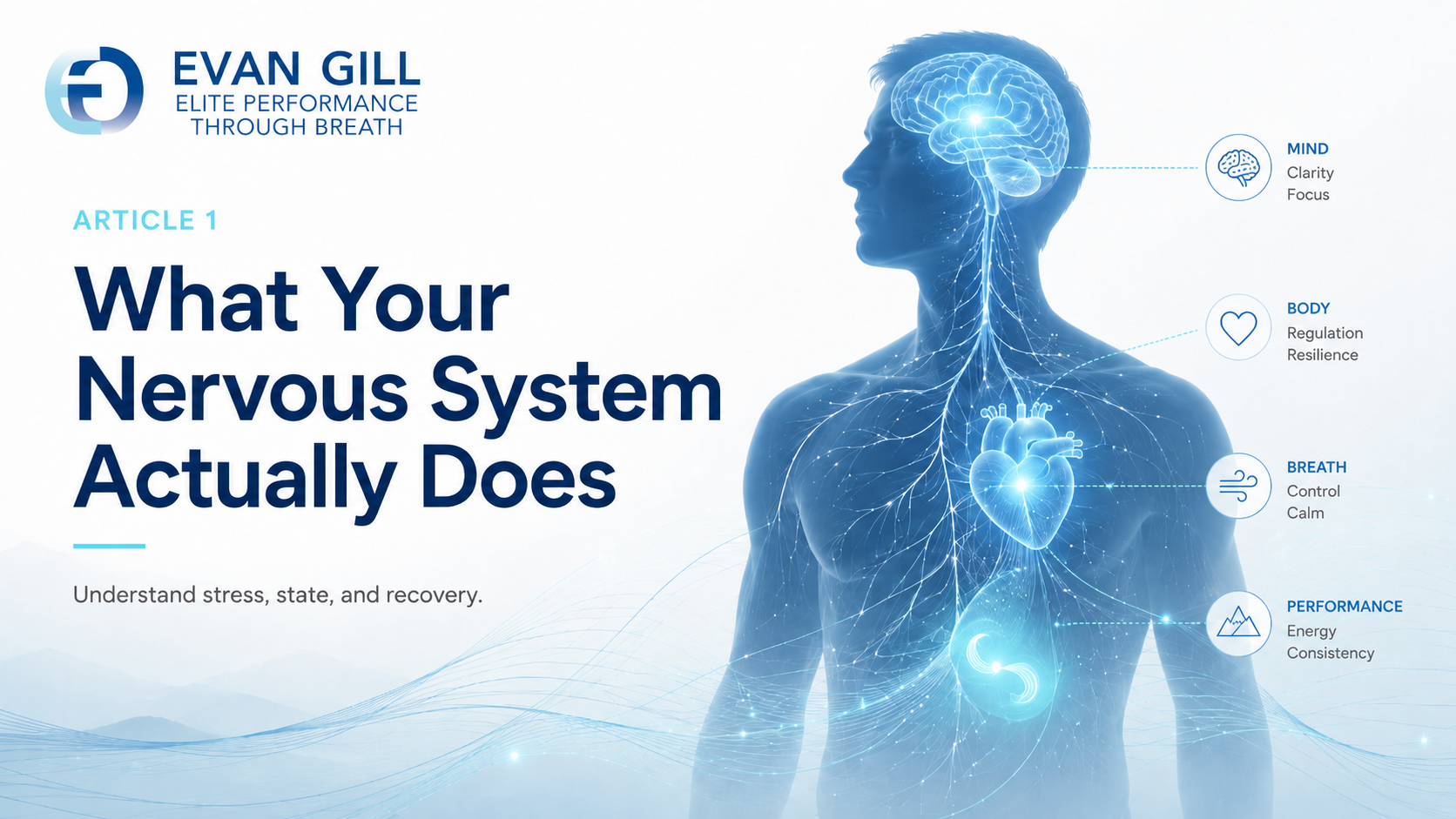
Your nervous system is constantly scanning your environment and deciding how much energy, focus, protection, or recovery you need.
Your nervous system is the communication network between your brain, body, and environment. It helps you think, move, breathe, digest, sleep, recover, and respond to pressure.
When people talk about being "regulated" or "dysregulated", they are usually talking about how well the body can move between different states. You are not meant to be calm all the time. A healthy nervous system can rise when you need energy and focus, then settle when it is time to recover.
For performance, this matters enormously.
If your body is too activated, you may feel tense, reactive, anxious, rushed, distracted, or unable to switch off. If your body is too shut down, you may feel flat, tired, foggy, disconnected, or unmotivated. Neither state is "bad". They are signals. The goal is to build awareness and control so you can shift your state more skilfully.
The breath is one of the most practical tools for this because it sits at the intersection of automatic and conscious control. You breathe without thinking, but you can also change your breathing on purpose. That gives you a direct way to influence your state.
When pressure increases, breathing often becomes faster, shallower, and more chest dominant. This can reinforce the feeling of stress. When you slow the breath, soften the body, and lengthen the exhale, you can send the body a signal that it is safe enough to settle.
This does not mean breathwork solves every problem. It means breathwork can help you create enough internal space to respond better.
Try this
Pause for 60 seconds. Notice your breathing without changing it.
Ask yourself:
Is my breath fast, slow, shallow, deep, smooth, or restricted?
Am I breathing through my nose or mouth?
Do I feel more activated, settled, flat, or tense?
Awareness comes before control.
Reflection
Where does stress show up first in your body?
Safety note
Breathwork should feel supportive. Stop if you feel dizzy, panicked, faint, or unwell. Seek medical guidance if you have a health condition that may be affected by breathing practices.